Beyond London: examining Heathrow's regional procurement strategy
Why the UK’s largest airport is courting regional businesses & what might hold it back

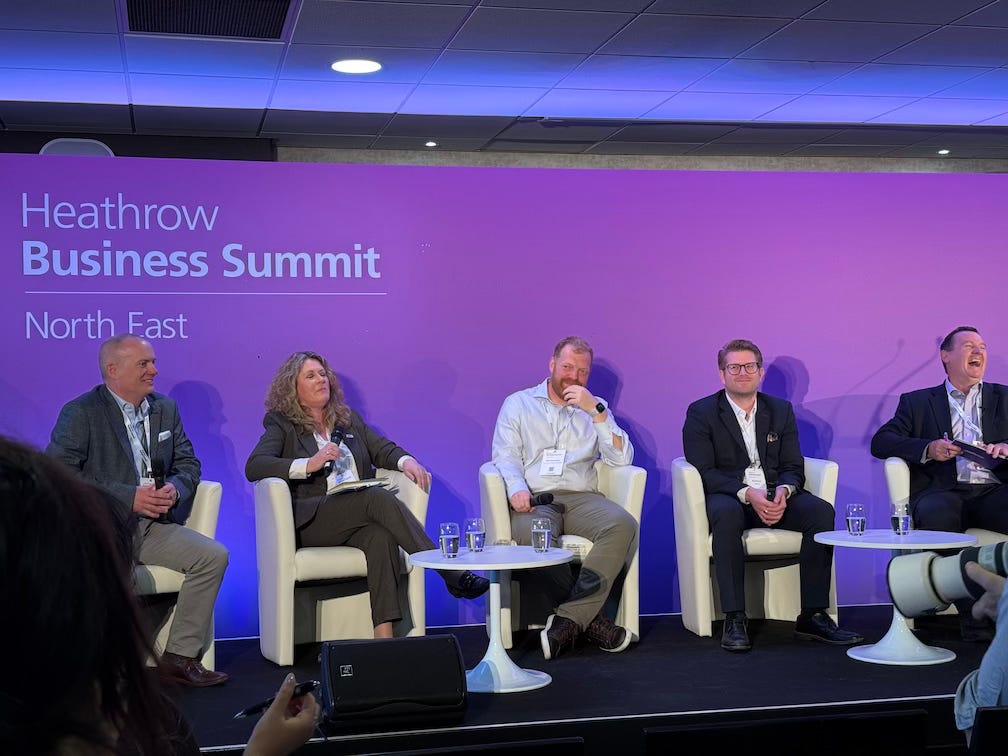
Have you noticed that while Heathrow’s airport code is LHR, clearly to show “London Heathrow”, their brand is just a clean “Heathrow”?
The decision is deliberate. The UK’s largest airport considers itself an airport for the whole country, not just London.
So when I heard that the airport was holding a Regional Business Summit in Newcastle upon Tyne, my home town, I knew I had to be there.
The event was great, positioning Heathrow as a national economic platform. Not only by attracting customers from the regions but, critically, British suppliers too.
In this article I will explain, from what I learned at the event, how they do it. I will then present my own analysis of Heathrow’s approach, including two challenges I think they will find it hard to overcome. I also think that Newcastle and the North East region has some specific challenges to overcome if they want to make it big in aviation.
After the analysis I have some photos of the event. Then right at the end I will repeat some of the jokes told by the speakers. Some are a bit cringey, but all the better for it!
Advertisement:

Heathrow’s growth & expansion presents an opportunity for North East businesses
£300 billion of imports and exports pass through Heathrow each year, making the airport the UK’s largest cargo port. 84.5 million passengers originated, terminated or travelled through Heathrow in 2025.
Only around half a million of these travellers are going to or from Newcastle – the region is a relatively small part of the UK’s overall economy – but they often fly in premium cabins.
The airport served 63,000 passengers in 1946, the year it opened (Heathrow will be 80 on 31-May-2026, just 23 days from this article). These days it takes only three hours for the airport to process a similar number of passengers.
Chi Onwurah, an MP representing the Central and West constituency of Newcastle, opened the event. She reckons that a third runway at Heathrow will generate £1.89 billion for the North East of England a year, by 2040.
She described the third runway, which will generate around 300,000 extra flight movements a year, as a national mission not a London one.
Newcastle Airport support the third runway too. They see it not as a competitor but an enabler of additional connectivity through Newcastle.
Ben Wheeldon, Major Projects Director at Heathrow, believes that 60% of the national benefits of Heathrow expansion will accrue to benefits outside London and the South East.
Those expansion plans are not limited to the third runway.
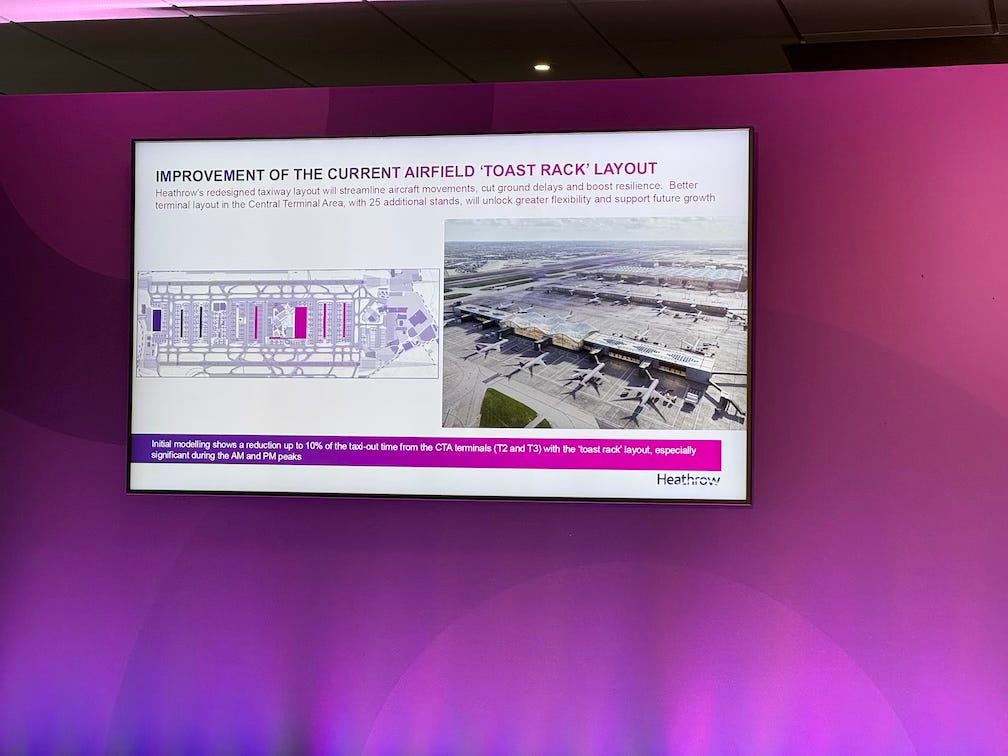
At the same time as building the new strip, Heathrow also plans to rejig their terminal set up. Under the “toast rack” model where terminal buildings extend through the airport site in parallel. The toast rack will expand capacity to 96 million passengers a year.
Terminal Three will need to be demolished. Opened in 1961, this is the oldest major terminal in operation anywhere in the world.
Two Terminal Five satellites will each increase capacity by around 20 to 30 million passengers, taking total capacity with the third runway to around 150 million passenger journeys per year.
And the third runway plus additional terminal capacity will not just help North East business and residents connect to international markets. It will also give Newcastle-based businesses an opportunity to participate in the supply chain.
This does not mean that Heathrow is looking for large-scale international businesses based in Newcastle. 60% of the airport’s suppliers are Small and Medium Sized Enterprises (SMEs).
63,000 people* in the North East work in advanced manufacturing of some kind. Newcastle is also the UK’s first AI growth zone, with a healthy number of tech startups – UK Startup & Scaleup Week has been held in Newcastle since 2017.
The region also has a clean energy industry, driven by the offshore wind facility at Blyth, which may be able to help airlines and airports achieve what the event called “jet zero” (eek! – Ed).
Accordingly Heathrow reckon that Newcastle’s local businesses may be able to provide solutions and opportunities that the airport has not imagined yet.
* the same number as Heathrow served in the year it opened!
Heathrow consider these events if they result in new businesses working with the airport. Unfortunately the process is not easy. SMEs are unlikely to become tier one suppliers and work with the airport directly.
Instead they will work through a larger third party who has that direct relationship. A certain amount of red tape is inevitable. However Chi Onwurah said “don’t let the red tape dim your ambition!”
What the tier one suppliers say
All of Heathrow’s tier one suppliers are required to work with SMEs.
These are not necessarily micro businesses. The British government defines an SME as one with less than 250 staff and either no more than £44 million turnover or less than £38 million on the balance sheet.
But the tier one suppliers are generally much larger. VolkerFitzpatrick, a construction co, reported £729.5 million in their UK entity’s 2024 accounts and spoke at the summit. They were represented by Matt Ghin, their Operations Director.
AtkinsRéalis, a Canadian engineering co, were represented by Director Phil Tarrant. Their 2024 report stated global revenue of CAD 9.7 billion (£5.2 billion).
Given that this was Heathrow’s conference, Mr Ghin and Mr Tarrant were suitably gushing, explaining how Heathrow is a great customer to have and how Heathrow make everything as easy as possible.
My impression was that Heathrow probably are trying to do as much as they can to reduce barriers to entry from SMEs, including businesses in Newcastle and the North East.
The airport says that they are looking for innovation, efficiency and speed all together. I do not see why this should not be possible – it is not the cheap/quick/good pick-any-two trilemma.
The tier one suppliers gave the impression that while Heathrow tries to avoid big tender documents with a detailed scope pre-defined by the airport, this is not always possible.
They advised SMEs to consider working with Heathrow an opportunity to “shape the conversation”. That way, when a tender is issued their products are likely to qualify.
It is quite likely that many SMEs have products that with a few tweaks could plausibly be used at Heathrow.
But a large amount of the discussion was about tangible products – earth moved, water diverted, buildings erected. So when the time came for questions I asked about SMEs who provide services and software that Heathrow might need.
The reply was that Heathrow has a different team for services and software procurement, but the end goal was the same. The airport is looking for new ideas and better ways of doing things.
Another audience member asked about how Heathrow learn from other sectors. The suppliers reply was that they find it easy to get “tunnel vision” working on a Heathrow programme. They said that while “it is easy to want to be curious”, unfortunately “the day job gets in the way”.
What the SMEs say
Two SMEs were represented at the summit.
Inventrite, who are too young to yet have filed accounts, produce a rechargeable lamp battery. Their owner Paul Cole told the story.
In March 2026 there were 175 of their batteries providing light for night time runway maintenance at Heathrow. More are coming soon – next month there will be 400 of Inventrite’s batteries at the airport.
Mr Cole’s message to SMEs about working with Heathrow was “don’t fear it, do it!” He said that
The Pallets Yard buy, sell and repair wooden pallets. These are used in industries all over the world, including at Heathrow. Their latest accounts show assets of £140,691 at 31-Dec-2024 – quite different to VolkerFitzpatrick and AtkinsRéalis.
Director of Finance & Admin Ruth-Anne Lynch said “Heathrow’s tier one suppliers need pallets, and they get them from The Pallets Yard”. She also described Heathrow’s “Lift Off” SME academy as “a bit like Dragons’ Den”, a TV programme where SME owners pitch for investment.
As with the tier one suppliers, I felt that Heathrow did a good job exhibiting the tangible. But it remains harder to see how service and software suppliers from the North East can work effectively with the airport.
Heathrow will face two different types of challenges working with North East businesses
Heathrow’s event was held very much in a can-do spirit. They had representatives from tier one suppliers and SMEs who supply the airport. However my take is a little more sceptical. I have two issues.
The first is that for every SME who ends up working with the airport, there must be many who do not.
Heathrow’s speakers encouraged people to talk to them, which is good. But from their perspective success is working with new businesses, not necessarily any one business in particular.
Heathrow enjoys the benefits, businesses incur the costs – a classic externality. As a result Heathrow will probably get fewer expressions of interest that would be economically efficient.
The second issue is one of incentives for business owners. Imagine you are taking £150k in dividends each year from a small business in the Team Valley, a trading estate in Gateshead, just south of Newcastle.
There may be opportunities to increase your profitability by working with Heathrow so you can take £250k in dividends instead. But your business is profitable enough and there are probably easier ways of expanding than going to Heathrow and it’s red tape.
It is hard to see how Heathrow will overcome these two challenges.
Subsidised bidding could help, but might attract less well qualified suppliers who would need to be weeded out later.
Pre-qualified SME pools would add an extra administrative hurdle without necessarily solving a core problem that not all SMEs realise they can work with Heathrow or, if they do, are unsure how to go about doing it.
Revenue guarantees might attract chancers.
Heathrow’s current approach – being open and welcoming and happy to chat – is probably their best bet given real-world constraints.
Newcastle also faces some specific challenges
Dawn Huntrod, Regional Director North at Make UK, referred to Northern Ireland in a panel discussion. She said that the North East is the UK’s second smallest manufacturing region after Northern Ireland.
The comparison is interesting. Northern Ireland may have a small manufacturing base, but it is highly relevant in aviation.
Northern Ireland is a centre for manufacturing aircraft seats. The Qatar Super Diamond Business Class seat from Qatar Airways’ Boeing 787s and Airbus A380s was manufactured at the Collins Aerospace in Kilkeel near another Newcastle, this one in County Down.
Any passengers who have flown Emirates Business Class from Newcastle (upon Tyne) are likely to have sat in a seat made in Northern Ireland too.
Where the English Newcastle may face challenges is in finding something specific and being known as a place meeting that aviation need.
Industrial clusters win contracts, not regions. Newcastle already has an energy cluster – could solar panels for airports be something the region becomes famous for in aviation?
PowerRoll Solar for example are based in County Durham a few miles south of Newcastle. They produce solar panels that can be rolled up and fit into odd-shaped places. Could a specific function like that be relevant to airports? Maybe.
Newcastle also has software and life science clusters – perhaps software that enables biometric scanning could become the region’s key contribution to aviation?
Clean energy, advanced manufacturing, culture, life sciences, tourism and the North East’s other industries sound impressive but are too generic. The North East will need to get specific and market its industrial base as relevant clusters if it wants to become the go-to place for something aviation related.
Show me the photos!
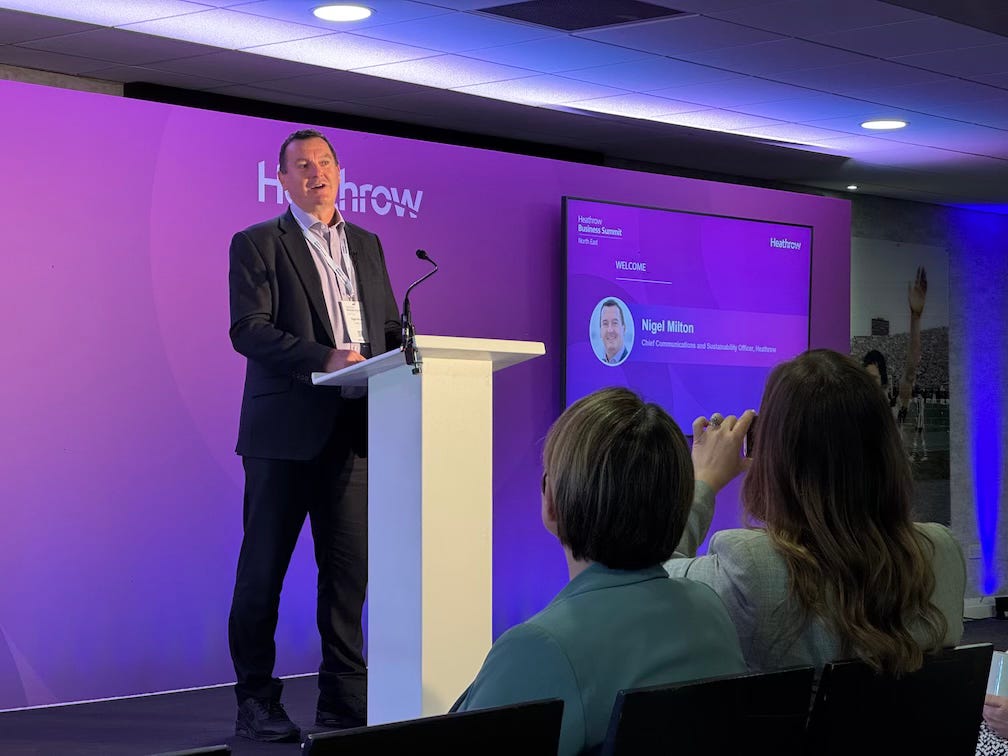
Here is Heathrow’s Chief Communications & Sustainability Officer Nigel Milton, who was em-cee of the day:
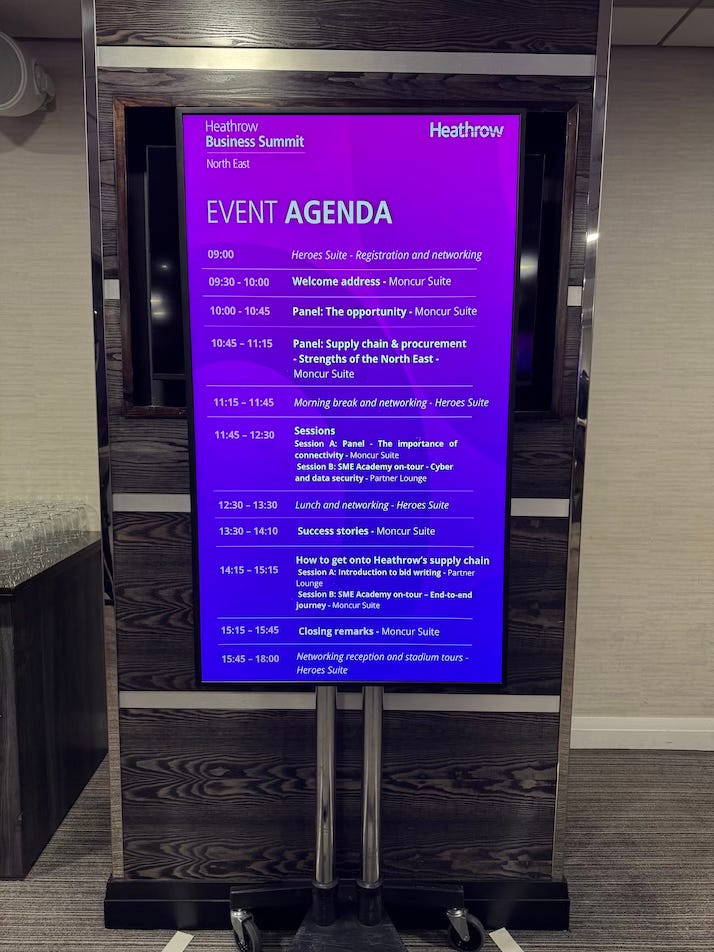
Here is the day’s agenda:
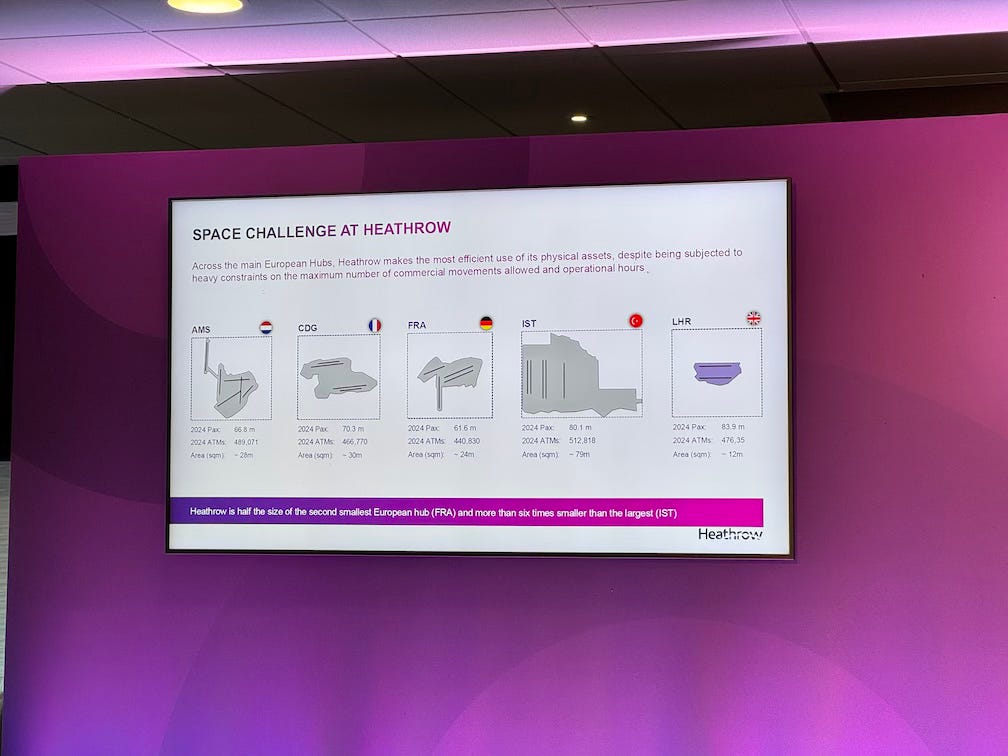
I really liked this slide showing how small Heathrow is compared to some other major European airports:
This slide explains the “toast rack”:
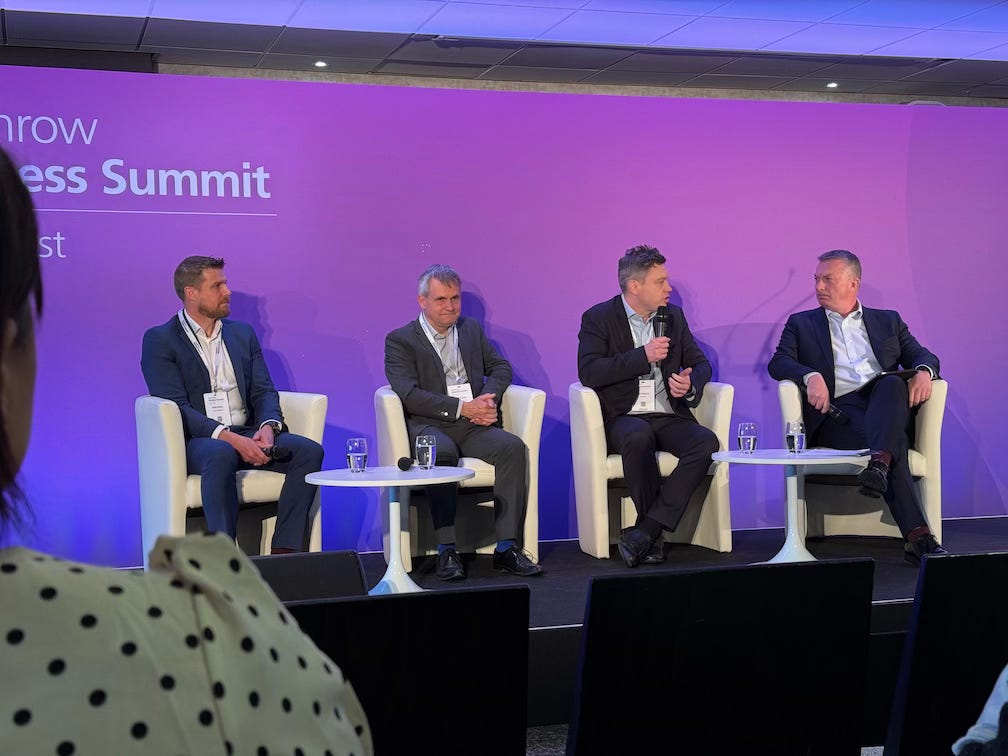
Here are the tier one suppliers – Procurement Director Paul Doherty is speaking and on the right is the panel’s Chairman, John McCabe from the North East Chamber of Commerce – from the left are Mr Ghin and Mr Tarrant:
Some humorous asides
The conference was not without its lighter moments. Heathrow’s Procurement Director Paul Doherty remarked that professional footballer is the only job not available at the airport. There is not currently a Heathrow United playing in the football league.
Mr Ghin, Mr Tarrant and Paul Doherty described themselves as “the world’s best boy band specialising in infrastructure”.
Conclusion
Heathrow’s message to the regions is clear: this is not just London’s hub, it is national infrastructure and it wants to behave like it.
The Regional Business Summit showed that this is more than branding. Heathrow is making a genuine attempt to draw in regional suppliers, spread economic benefits, and position Heathrow as a platform for British industry rather than just a gateway for passengers.
But good intentions do not remove structural constraints. For many SMEs, the cost and complexity of engaging with Heathrow’s supply chain will outweigh the potential upside. And at a regional level, broad capability is not enough as regions that succeed as aviation suppliers like Northern Ireland tend to specialise, not generalise.
If Heathrow can lower the barriers to entry, and if regions like the North East can define a clear and differentiated role within the aviation ecosystem, then the model has a chance of working.
If not, the risk is that “Heathrow for all the UK” remains a compelling narrative but an incomplete reality.