How much should you pay for a Neighbour-Free Seat on Virgin Atlantic?
Optimal bidding strategies for empty adjacent seats

During my first and to date only airline job interview I was told that I was being considered for two positions.
Pricing Strategy Analyst was the one I got. The other: Distressed Inventory Analyst.
Distressed inventory operates outside of the normal sales, promos and premium tactics deployed by an airline’s Pricing team because these reflect the monetisation of demand and capture of market share.
Distressed Inventory is distinct because it is all about moving seats that have no or almost no demand. They would otherwise be hard or almost impossible to sell.
Advertisement:

Group and bulk deals are one possible solution, though demand is lumpy and sales not always likely. Another option is reducing fares close to departure, although this teaches the market to buy late and is not desirable. Offering seats for points redemptions can be another good option.
Virgin Atlantic seem to be launching a novel form of distressed inventory pricing. “Neighbour-Free Seating” has appeared in the terms and conditions. Virgin Australia operates a similar scheme. Web search suggests that Etihad may have done so in the past.
In this article I want to answer a question. What can Revenue Management principles and published fare data tell us about the optimal amount to bid for an empty middle seat?
Some basic principles
The process is an auction, like the famous upgrade auctions. This blog is not a supporter of upgrade auctions. They are unpredictable and can lead to disappointment.
Thanks to the winner’s curse, passengers might be better shopping around for Business Class outright. Airline Pricing teams would be better off promoting deals for Business Class advance purchase instead.
Neighbour-Free Seating is a better bet. Passengers will book and fly Economy. There should be no unfortunate surprises. But it remains to be seen if Virgin Atlantic will renege on a successful bid if they need to accommodate last minute mis-connecting passengers on a later flight.
On many flights a few seats remain unsold or have extremely low value thanks to the Law of Demand. Neighbour-Free Seating delivers a tangible passenger benefit at low opportunity cost for an airline.
I support Neighbour-Free Seating and recommend it as a good idea in Revenue Management.
Some ground rules
Passengers bidding for a Neighbour-Free seat should consider two points.
First is that a rational passenger should not bid close to the Economy to Premium cabin fare difference. In most cases they would otherwise be better off just upgrading outright.
Second, take clauses 4.1 and 4.2 from the airline’s terms and conditions:
“Virgin Atlantic selects successful bids at its discretion, considering availability, number of bids received, and bid amounts … Virgin Atlantic does not guarantee you will receive Neighbour-Free Seating, even if seats are available or your bid is the highest.”
I would interpret this as “don’t take the mickey”. Virgin Atlantic is unlikely to accept low one Pound-style bids.
I would consider two strategies:
1. Bid the commercial empty seat price
2. Bid half the commercial empty seat price
Since Virgin Atlantic may seat passengers buying the Neighbour-Free Seating in the same row, the half price might seem fair.
You should not include airport taxes and charges in this price. Should you include the YQ and YR surcharge in your bid? I think you should, as we will see below.
Bids on 787-9 & A350-1000 may be more likely to be accepted
I think that bids on Virgin Atlantic flights operated by their A330-300 and A330neo fleet are less likely to be successful. This is because of the eight-abreast 2-4-2 aircraft configuration.
There are only two middle seats per row, in the middle of the central 4-block. Blocking a side 2-block seats removes a desirable window or aisle seat from general circulation. In practice Virgin Atlantic may prefer to block the central two seats only.
So only 25% of the seats on these planes are theoretically available for Neighbour-Free Seating.
Meanwhile on the 787-9 and A350-1000 flights, the nine-abreast 3-3-3 configuration is more friendly. Every middle seat is in a block of three. That means 33% of seats are theoretically available for Neighbour-Free Seating.
That extra 8% (33% - 25%) of seats are the ones most likely to appear in the airline’s distressed inventory.
What is a reasonable price to pay on London to San Francisco?
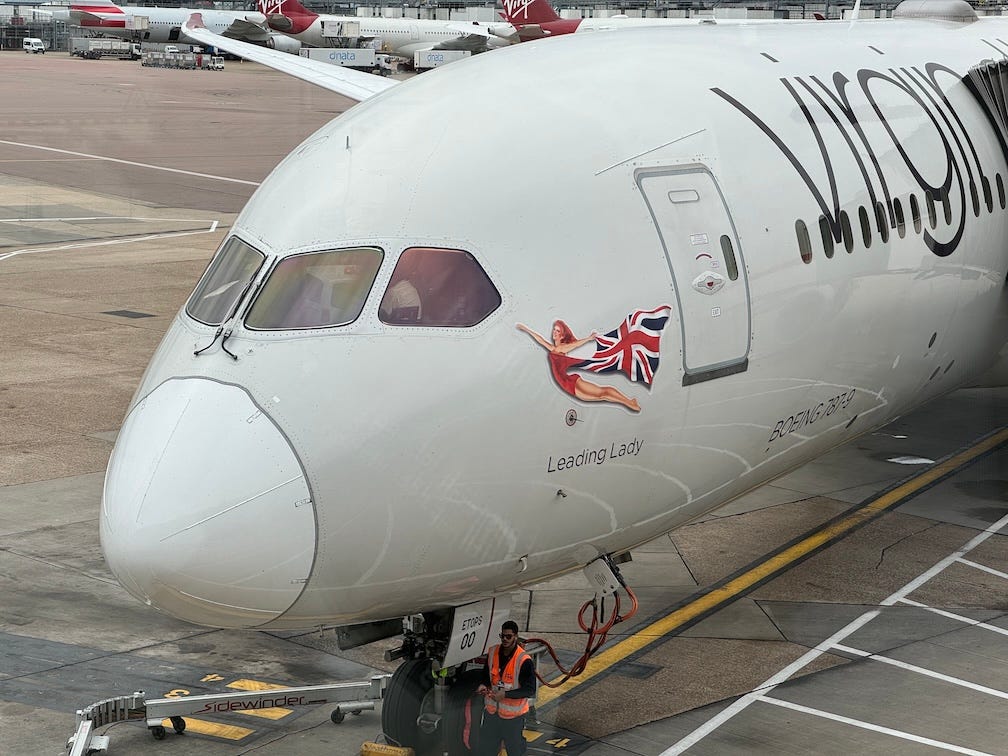
I flew Virgin Atlantic’s 787-9 to San Francisco. It is sometimes operated with the 787-9 and sometimes with the A350-1000. That makes it a nine-abreast route where Neighbour-Free Seating may be more likely to be available.
For a flights departing on 16-Sep-2026 and returning on 23-Sep-2026 the lowest four published return fares all book into class T and are:
£3 / £6 / £17 / £22
These fares really are currently sold. At the time of writing the £6 return fare (£3 one-way) is valid for Virgin Atlantic’s outbound VS19 flight to San Francisco on 16-Sep. The £3 return fare (£1.50 one-way) is valid on the return VS20.
This is why I think the carrier surcharge is relevant. A £3 or £1.50 bid violates the “don’t take the mickey” principle. Virgin Atlantic is unlikely to accept these.
The carrier surcharge is £330 YQ plus £14 YR, so £344 in total. Half of this is £172.
So for the outbound flight VS19 on 16-Sep there are two sensible bidding options:
1. Full value bid = £3 one-way fare + £172 carrier surcharge = £175
2. Half value bid = £175 / 2 = £87.50.
We can take a simple rule of thumb from this:
EITHER
Bid either half the YQ + YR carrier surcharge plus a couple of Pounds – this is the strategy to follow if you really want the empty adjacent seat
OR
Bid a quarter of the YQ + YR carrier surcharge plus a couple of Pounds – this is the strategy to follow if you would quite like an empty adjacent seat but are not too bothered, or if you like a bit of risk.
The intuition behind this rule of thumb is simple. In markets where the entry fares are just a few Pounds, the YQ + YR carrier surcharge is essentially the Minimum Acceptable Yield that Virgin Atlantic will accept. It is, in effect, the distressed inventory price.
Unless you are on a one-way ticket, you need to bid half or a quarter, because the YQ and YR is calculated on a return basis.
Since the YQ and YR are quoted to passengers on their e-ticket receipts the information is readily available.
Travellers flying on a package might need to be a bit more savvy and use a tool like ITA Matrix to look this up though, as their e-ticket receipts might not contain a fare calculation.
Does the rule of thumb work elsewhere? Let’s take a look…
What is a reasonable price to pay on other routes?
