Pricing the same departure twice: a natural experiment in railway pricing
A data-led look at how LNER prices speed, stops & scarcity across Standard & First Class

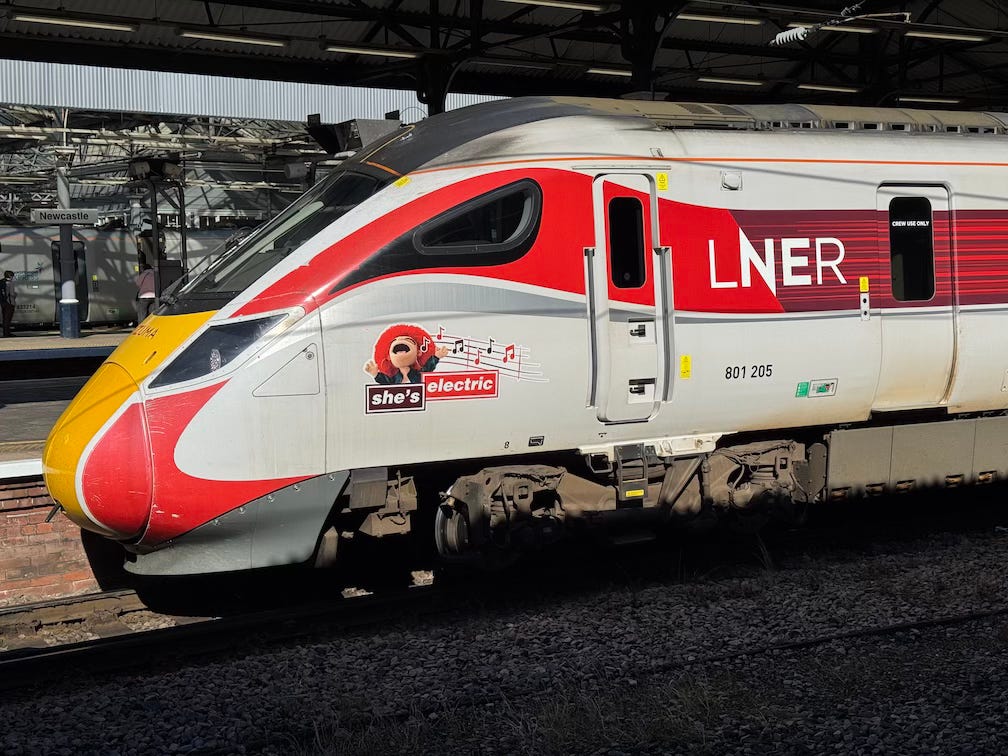
Every now and again it is fun to analyse those special planes that have no wings, never take off and run on rails. Today’s article is about trains!
Rail and air have much in common. They can both carry large numbers of passengers long distances. They both have significant fixed infrastructure and a prominent safety culture. And they both practice Revenue Management.
British operator LNER operate the King’s Cross to Edinburgh services via York, Newcastle and other towns along the East Coast Mainline.
Their new timetable, launched in December 2025, presents an interesting example of value-based and displacement-based pricing.
Advertisement:

Each day there is a train from Newcastle, my home town, to King’s Cross at 12.24pm and another only three minutes later at 12.27pm. The departure times are, essentially, the same.
However the 12.24pm train arrives into London at 3.10pm two hours and 46 minutes later. It stops only at York.
Meanwhile the 12.27pm train takes three hours and five minutes to reach King’s Cross. It stops at Durham, Darlington, Northallerton, York, Grantham and Stevenage, arriving at 3.32pm, 22 minutes later than the other service.
I call these trains “fast” and “slow” respectively. This is a bit unfair – they are both good options to get to London, which is nearly 300 miles from Newcastle.
How should LNER price the two trains? From a Revenue Management perspective the operator has two choices:
1. The faster train could be more expensive because people will value the speed
2. The faster train could be cheaper because LNER wants to save seats on the slower train for people from other stations.
Which do LNER choose? I decided to investigate…
I collected 119 price points from the next 18 weeks. The dates in the sample are Wed-13-May-2026 to Tue-15-Sep-2026. The source was the operator’s website, lner.co.uk.
There are no trains on 23-May, 24-May and 25-May due to engineering works over the bank holiday weekend.
There are no fares available between 28-Aug and 31-Aug, the next bank holiday weekend. I am not sure whether this is due to engineering works or timetables that are yet to be finalised.
The chart below shows the fares currently available in Standard Class.
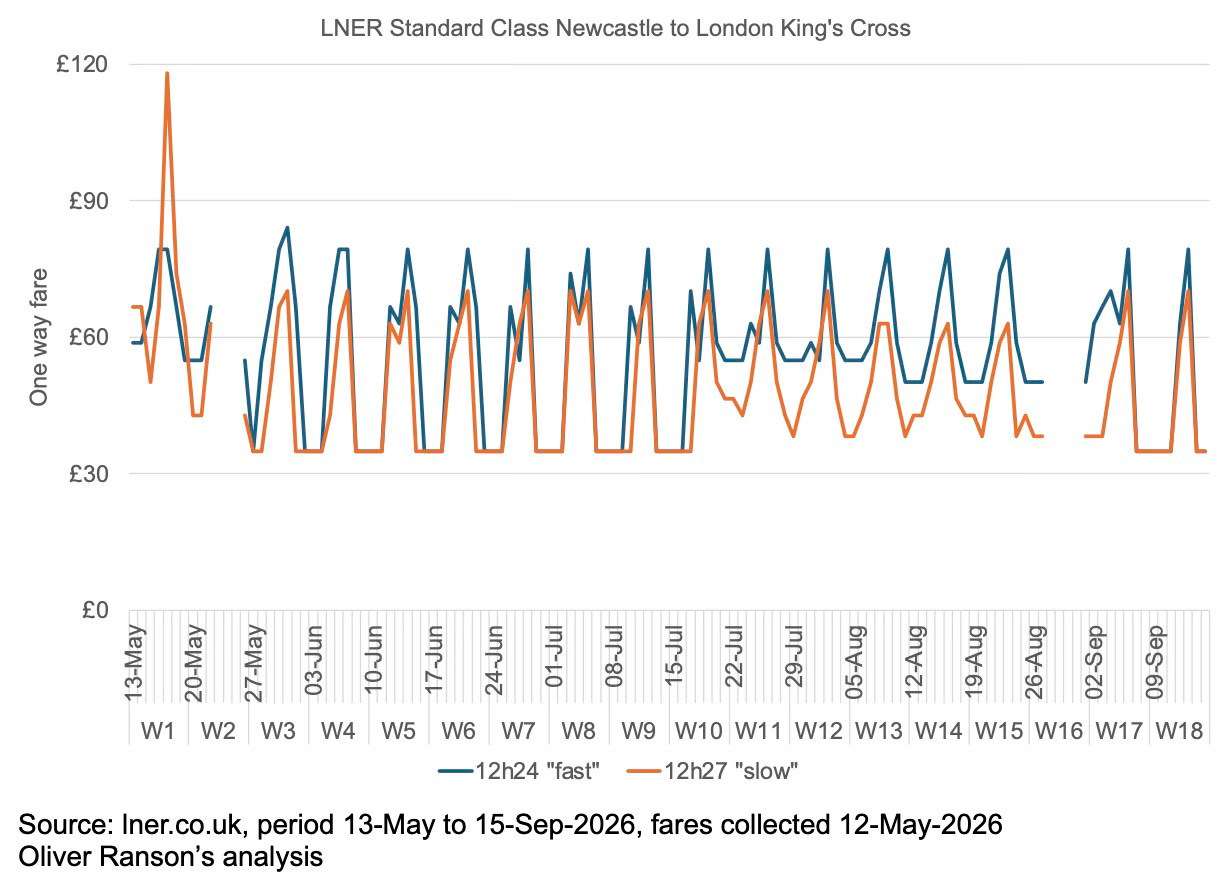
The minimum fares are £34.90 on both trains. This fare is available on 39 out of 119 “slow” services and 33 of the “fast” ones. They are also both the mode fares.
The maximum fares – £84 on the “slow” and £118.10 on the “fast” – are each only required on one train. Median fares are £54.90 on the “fast” train and £42.80 on the “slow” one.
The “fast” train is more expensive in 74 cases. The “slow” train is more expensive on only ten days. Both trains are the same price on 35 days and on 33 of these both trains are priced at the cheapest £34.90 fare.
The evidence is clear. Most of the time LNER is commanding a premium for the “fast” train.
But there are two other interesting points.
