
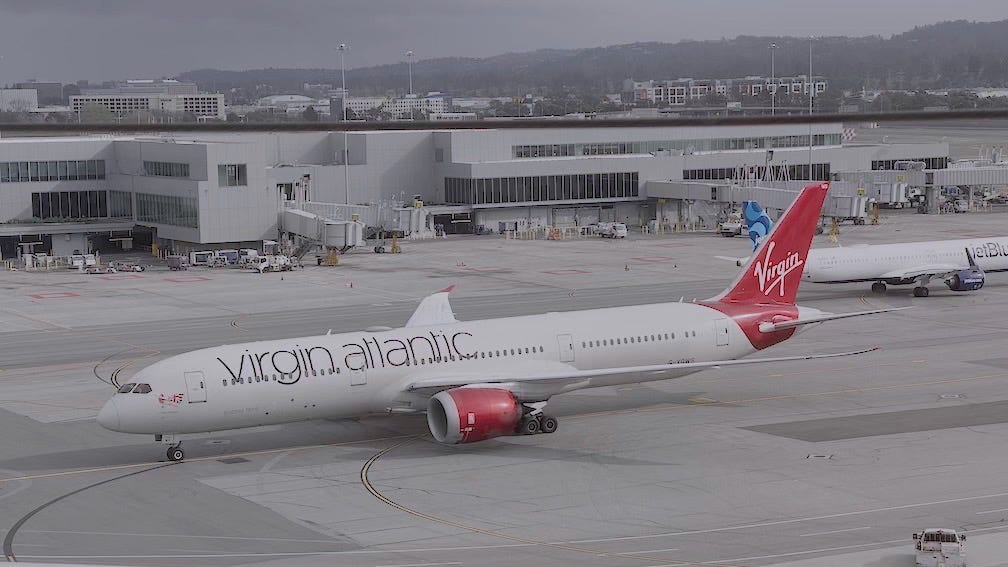
Virgin Atlantic is the real deal. El ultimo grito. Accept no imitations.
The groovy-funky airline’s success has been a boon for British consumers and grown up to be a fabulous brand ambassador for the United Kingdom.
Virgin Atlantic even contributed to the success of British Airways. For without competitive pressure from their upstart rival, BA would probably not have launched the first fully-flat beds in Club World business class as early as they did.
It is also a miracle that Virgin Atlantic is still with us 41 years after Sir Richard donned his fancy dress pilot kit and sent a 747 on it’s way to Newark (the one in New Jersey, not Nottinghamshire (boom! boom!!).
Smaller British airlines do not have a track record of faring well for the long term.
Freddie Laker’s outfit plied the Atlantic air routes for 15 and a half years until the 1982 recession. British Midland never really recovered from the 2008 financial crisis and merged with British Airways in 2012. Regional turboprop operator Flybe was finally done in by the Covid pandemic.
There have been plenty of opportunities for Beardy’s outfit to go bust. All the above plus the bursting of the dot-com bubble and nine-eleven. Yet fortunately they continue to survive.
So when I read that current CEO Shai Weiss will step down at the end of this year I felt sorry to see him go and a great hope that his successor Corneel Koster will succeed too.
Mr Weiss guided Virgin Atlantic through the tricky times of the pandemic. And on his watch Virgin Atlantic transitioned from an operator of large 747 jumbo jets and A340-600s* to a more boutique fleet of 787-9s and A330s, plus a dozen data generating A350s.
[* When I first started doing business travel in 2006, I remember seeing “4 engines 4 longhaul” proudly painted on Virgin Atlantic’s A340s. The past is truly a different world...]
Mr Weiss has left the airline in a good place. The Clubhouses thrive. The comfy but old Upper Class Suites are due for replacement with popular Retreat Suites first seen on the A330-900. And lightning fast Starlink Internet access is due for rollout.
Yet the airline still faces challenges. The airline’s partnership with American mega-carrier Delta must not be allowed to overshadow the quirky British brand. The network is arguably over-exposed to the United States market. The loyalty scheme is poorly designed for British consumers in the airline’s home market.
But there are opportunities too. Mr Koster’s watch should see the airline start to use data generated in the cabin at scale to improve the passenger experience. There may also be a chance to innovate in the airport.
Let’s take a look at each of these to see what a blueprint for Mr Koster’s success might look like.
Data generated in the cabin can make flying better for everyone
Long-term readers of Airline Revenue Economics will remember that I am a big believer of data generated in the cabin to help airlines develop better products and services.
In 2021 I wrote about how state of the art planes like Virgin Atlantic’s A350-1000s and A330-900neos have digital backbones that can collect data in real time. The Airbus Skywise platform collates all of this information.
Skywise subscribers can, in return for sharing this information with other airlines, receive data not just from their fleet but for all the planes of that type flying with any airline.
When it comes to maintenance and safety, airlines are keen on sharing the data.
But Skywise data can also be used to collect information about how passengers are using seats and screens, as well as what is going on in the galley.
This matters, because it will allow airlines to see in great detail how real-world flights with similar characteristics vary. Products and services, meals and catering load can be tailored accordingly.
Some flights are clearly different to others. Virgin Atlantic’s flight VS26 leaves New York around eight in the morning and gets into London around eight at night. Clearly pasengers are going to behave differently on these flights to those overnighters, especially in Upper Class with it’s desirable flat beds.
But is there a difference between the VS4 6pm departure/6am arrival flight and the VS4000 8pm/8am flight?
Without data, you could argue either way.
The 6pm/6am flight could be full of short-stay business travellers returning to London. They will be still be on UK time and 6pm in New York is 11pm in London – time for bed with no need for a meal.
On the other hand the 8pm/8am flight might be full of New York-originating travellers because a 1am UK time departure and 8am UK might seem a little late for UK-originating short-stay business travellers keen to be in the office at 9am.
With data, Virgin Atlantic will be able to see the trends, such as when people put the seat into bed mode, how long they watch movies for, and how many of the ovens are turned on in the galley.
Airlines will not be keen on sharing data that is collected in the cabin. It might even be considered as some of the most commercially sensitive data that they have.
In 2022 I had a chance to visit a Virgin Atlantic press conference and asked Shai Weiss and Delta’s boss Ed Bastian about data in the cabin.
Here is the question I asked:
You mention the importance of services, which is something Airbus has been talking about a lot. It is well-known that Airbus’s ‘Skywise’ platform is generating data that airlines are using to improve maintenance and aircraft performance.
But Airbus are now talking about using Skywise data to understand how passengers experience products like seats, service and entertainment in the cabin, like we see with the Airspace Cabin Vision 2030 which recently won a Crystal Cabin Award.
Do you believe in this model and what services do you think we will see Delta and Virgin Atlantic introduce in the cabin as a result?
And here is what I wrote about the answer I received:
Ed gave a chuckle when he heard this question – a friendly chuckle I think. His answer was most interesting and it came in three parts:
1. Yes, Delta loves to look at new sources of data and the Skywise platform is well integrated into the operational side of the business in engineering, maintenance and so on
2. Yes, there is huge potential to use data to understand how passengers use the products in the cabin and translate that into revenue growth – Shai agreed on this
3. But no, Delta will not be using Skywise to do it – they will build their own data collection platform into their seats and galleys.
I think that this is really interesting. Delta clearly value the data that will be generated in the cabin so much that they are going to build their own proprietary technology to do it. As a result they will certainly not be sharing it with other airlines and suppliers, which is part of the Skywise ethos. It is nice to know they share my vision.
Then lo and behold, at Aircraft Interiors Expo in 2023 I had the chance to visit the Delta Flight Products stand and see Delta’s data platform, SkyPulse, in action.
I would imagine that Delta and Virgin Atlantic are busy collecting data using SkyPulse right now. Or if they are not, they soon will. Mr Koster will be the first Virgin Atlantic CEO and one of the first airline CEOs to have the chance to use this data at scale to enhance the passenger experience.
Here are some examples of what I believe Virgin Atlantic under Mr Koster’s leadership should be focusing on:
1. The correlation between passenger behaviour and the times of day that the flight departs, in local time at both the point of origin and the point of arrival
2. How do passenger order from the galley – for example when in typical flights call bells are often pressed and to what extent are the screens are used to order drinks or duty free at different stages of the flight
3. When do people sleep and when do they wake, especially in Business Class – ideally there would be a link to the galley telling the crew which passengers have recently moved their flat-beds from bed to sitting mode, or other seats from fully to partially reclined, as the crew can then offer proactive services that will make passengers feel special.
The Flying Club loyalty scheme needs to be split in two
Keep reading with a 7-day free trial
Subscribe to Airline Revenue Economics to keep reading this post and get 7 days of free access to the full post archives.